
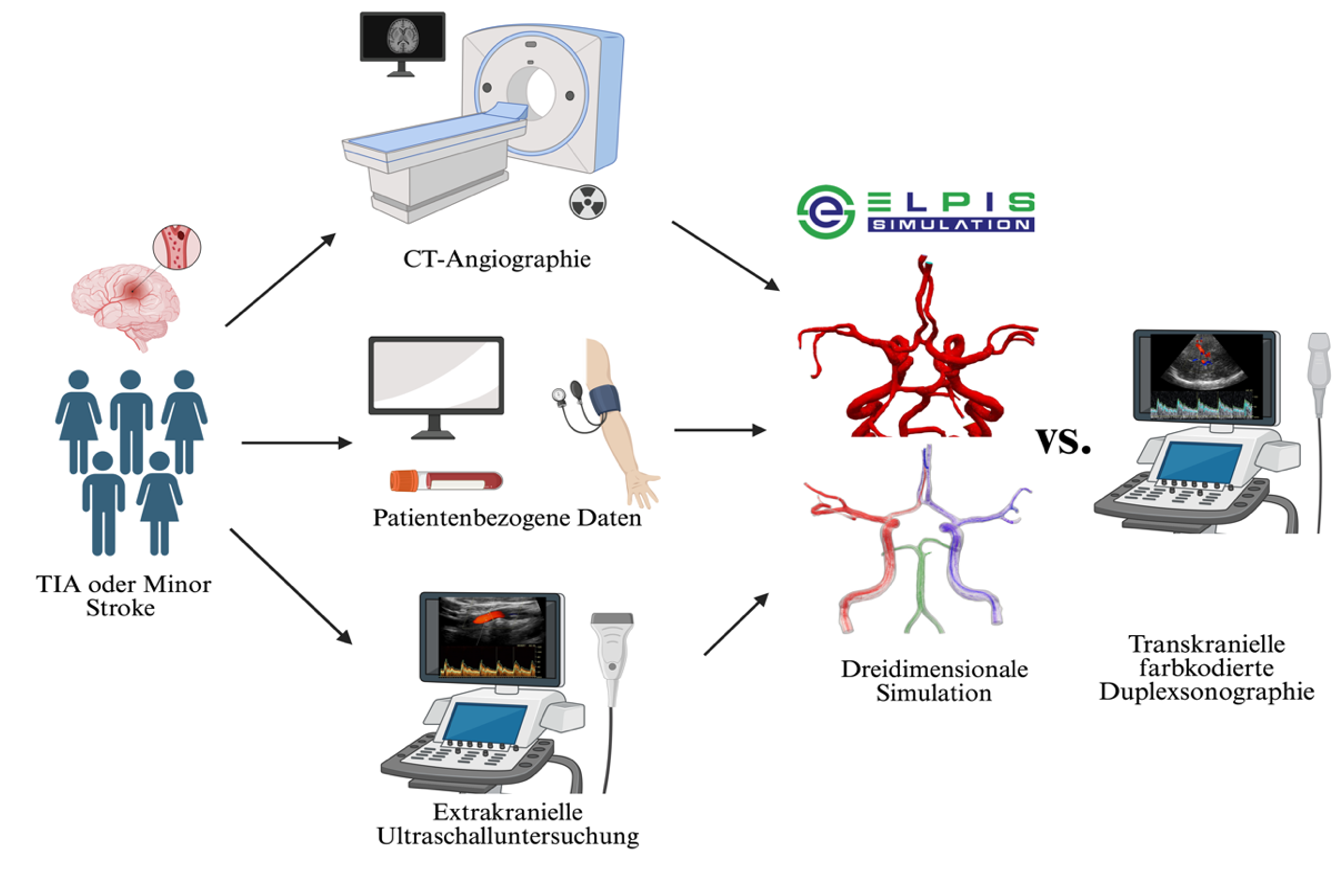
Three-dimensional simulations of cerebral blood flow could help to individualise diagnosis and treatment of cerebrovascular disease. A prerequisite is that simulated values match measured ones.
In the study by Dr. Johanna Leyhe (first author) and Prof. Ilko Maier (senior author), patient-specific vessel models were built from CT angiography for 53 patients with TIA or minor stroke without relevant large-artery atherosclerosis. Flow velocities computed with the StroQ software (ELPIS Simulation GmbH, Hann. Münden) were compared with transcranial colour-coded duplex sonography as the clinical reference. Differences were small overall, and agreement was good to excellent for most intracranial arteries.
Such simulations might in future help to tailor blood pressure targets or support decisions on procedures such as carotid surgery or stenting. Further studies are needed.
Original article: Leyhe JR, Reinecke-Lüthge CM, Jamous A et al. Three-dimensional, patient-specific simulation of cerebral blood flow velocities as a new approach for individualized stroke prevention and treatment. Comput Struct Biotechnol J 2025;28:321–329. doi:10.1016/j.csbj.2025.08.022 (PMID 40933852)